
The Gambling Harm Index: what all 50 states and DC publish about gambling harm
First published September 21, 2026. Dataset version 2026.10.2; last corrected October 5, 2026. The index is updated as soon as a state's data changes or a correction comes in; every change is dated in the Corrections below.
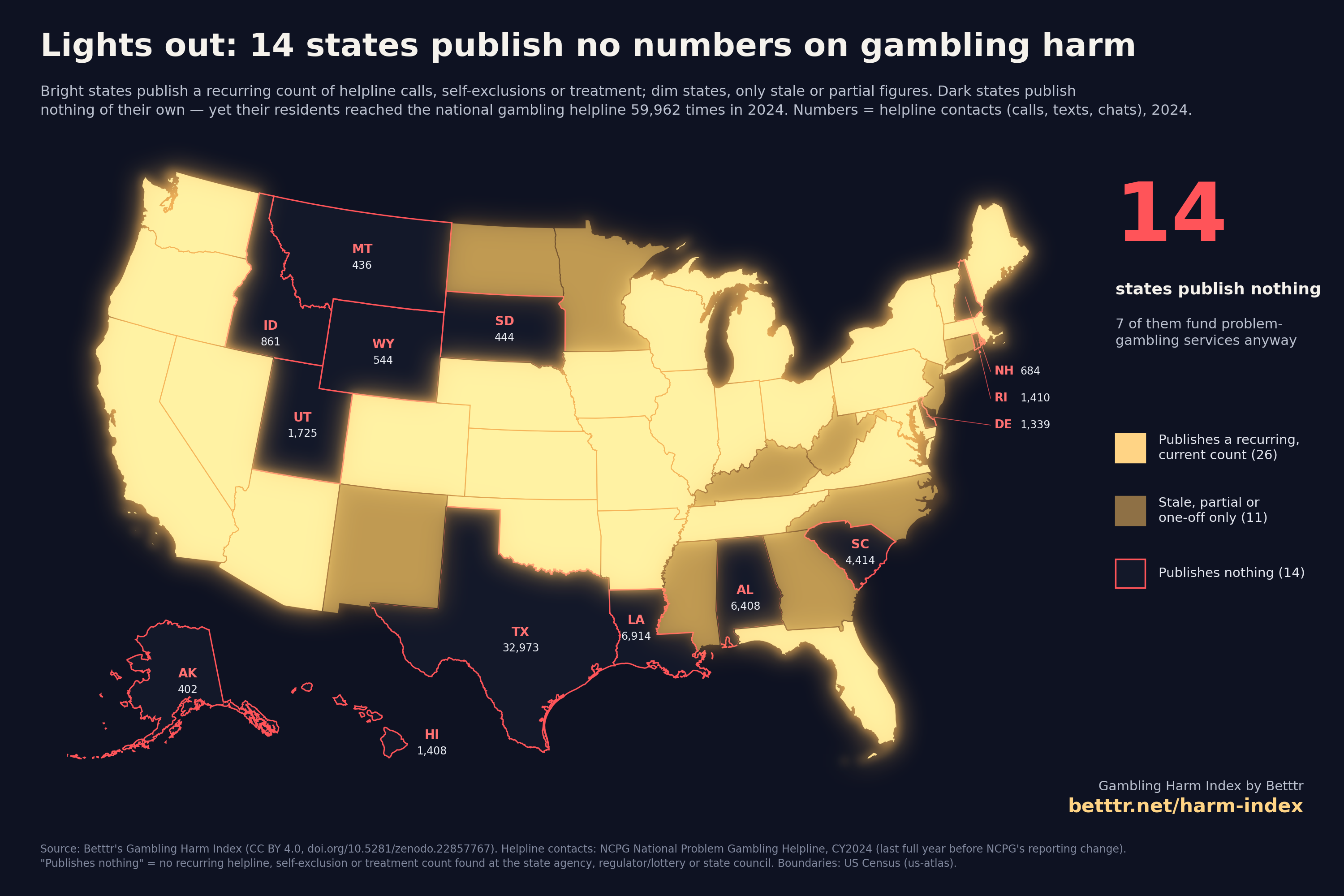
Every serious story about sports betting quotes a helpline number, and almost nobody says where it came from. We went looking for the source and found there is no source — there is a 7.8 MB annual PDF from a national council, a handful of state reports on different fiscal years measuring different things, and a large number of states that count nothing at all. So we built the table that should already exist. This is every gambling-harm indicator that a U.S. state, the District of Columbia or a national body publishes to the public, in one place, with the URL attached to every figure. Where a state publishes nothing, this page says so; fourteen of them publish nothing, and seven of those fourteen spend public money on problem gambling anyway. A free CSV sits at the bottom. It is updated as soon as a state's data changes, and every change is dated.

This edition has material corrections. Read the appended corrections.
The three findings
Fourteen states publish no recurring gambling-harm count at all — and seven of them fund problem-gambling services. Alabama, Alaska, Delaware, Hawaii, Idaho, Louisiana, Montana, New Hampshire, Rhode Island, South Carolina, South Dakota, Texas, Utah and Wyoming publish no helpline count, no self-exclusion count and no treatment count. Delaware, Louisiana, New Hampshire, Rhode Island, South Carolina, South Dakota and Wyoming all appropriate public money for problem gambling. Wyoming's statute directs $300,000 a year; Louisiana's directs $500,000 a year. Both publish the appropriation and no count of anyone helped by it. Money in, no count out.
Nobody publishes a machine-readable file — not one state, not the national body. Of 51 jurisdictions, 49 publish no machine-readable gambling-harm data at all; two are partial (Florida's archived PDFs, Pennsylvania's JavaScript dashboard with no export). Zero CSVs. Zero APIs. Zero JSON. The only genuine 50-state series in the country sits in Appendix A on page 36 of an annual PDF. One state publishes monthly (Michigan) and one publishes quarterly (Maryland); [Corrected 2026-09-23: Ohio and Maryland also publish monthly self-exclusion series — see Corrections below.] the other seventeen states that publish anything current publish once a year. [Corrected 2026-10-05: Arkansas's lottery also publishes a monthly helpline report.]
The national helpline total fell in 2025, and it is not a decline in help-seeking. Contacts went from 402,504 in 2024 to 377,410 in 2025. The national council's own report says call and text data were unavailable for October, November and December 2025 following a September 2025 court ruling, and instructs readers that the decrease should not be read as a true decrease in helpline contacts. Excluding those three months, the helpline averaged 36,723 contacts a month. Any headline reading "gambling helpline calls fell" is reporting a court case, not the country. Meanwhile the share of contacts naming online or app-based gambling as the primary problem rose from 22.77% to 31.36% in one year.
The national numbers
| Indicator | Period | Value | Publisher | Source |
|---|---|---|---|---|
| Total National Problem Gambling Helpline contacts | CY2025 | 377,410 | NCPG (analysis by Omni Institute) | 2025 Helpline Annual Report (PDF) |
| Total contacts, prior year | CY2024 | 402,504 | NCPG | Same report |
| Monthly average excluding the three unavailable months | CY2025 | 36,723 | NCPG | Same report |
| Average contact rate per 100,000 residents | CY2025 | 101.4 (state range 5.31–524.74) | NCPG | Same report |
| Channel mix | CY2025 | 92% call, 5% chat, 3% text | NCPG | Same report |
| Online or app-based gambling as primary problem form | CY2025 | 31.36% (22.77% in 2024) | NCPG | Same report |
| Traditional slots and electronic gaming as primary form | CY2025 | 30.95% (36.29% in 2024) | NCPG | Same report |
| Contacts citing financial struggle as the motivation | CY2025 | 73%+ (66.02% in 2024) | NCPG | Same report |
| Contacts aged 18 to 34 | CY2025 | 49.48% | NCPG | Same report |
| Contacts referred to gambling blocking tools | CY2025 | 5.41% (3.32% in 2024) | NCPG | Same report |
| Public monthly or quarterly national release | — | None exists | — | — |
The 51 state and DC figures in the table below sum to 363,588 for CY2025 and 394,155 for CY2024. The national totals are higher because they include Guam, the Northern Mariana Islands, Puerto Rico, the U.S. Virgin Islands and contacts with no state recorded; the four territories are a version 1.1 item. Across the 51 jurisdictions, 25 decreased year over year (23 at p<.001), 20 increased (18 at p<.001) and 6 showed no significant change. Given the three missing months nationally, read the direction, not the magnitude.
What every state publishes
Read this table as an inventory of what is published, not a ranking of harm. Only the last data column is comparable across states: it comes from one publisher applying one method to every jurisdiction. Everything to its left is each state describing itself, on its own fiscal year, counting its own thing. Adding the self-exclusion column up would be wrong, and we are not going to do it.
| State | State publishes helpline data? | State publishes self-exclusion enrollment? | Latest published self-exclusion count | Latest state-published helpline count | Helpline contacts, CY2025 (NCPG) | Source |
|---|---|---|---|---|---|---|
| Alabama | No | No | N/A — state publishes nothing | — | 3,606 | N/A — nothing published |
| Alaska | No | No | N/A — state publishes nothing | — | 527 | N/A — nothing published |
| Arizona ✎ corrected 2026-10-05 | Yes | Yes (annual) | 2,609 active (2,332 tribal casino; 277 event wagering and fantasy); 12,141 enrollments since inception (FY2026) | 2,867 calls + 1,526 texts (FY2026); 1,197 intake calls in 2024 (monthly series) | 5,591 | Arizona Department of Gaming — FY2026 Annual Report, p.18 · Arizona Department of Gaming — helpline data |
| Arkansas ✎ corrected 2026-10-05 | Yes (monthly) | No | N/A (statewide list not yet published) | 324 calls, 15 intakes (Aug 2026, monthly report) | 6,000 | Arkansas Scholarship Lottery — Problem Gamblers Helpline monthly reports |
| California ✎ corrected 2026-09-25 | Yes | No | N/A | Tier A — California Problem Gambling Helpline contacts — monthly interactive dashboard published by the California Council on Problem Gambling (updated by the 20th of each month for the prior month); the Council also publishes annual helpline reports. CDPH Office of Problem Gambling treatment and helpline reports remain at FY2015-16 and 2020. monthly series (live dashboard) | 52,885 | California Council on Problem Gambling · CDPH Office of Problem Gambling |
| Colorado | No | Yes | More than 1,300 (August 2026) | — | 6,944 | Colorado Division of Gaming |
| Connecticut | Percent only | No | N/A | No absolute count published (+1% vs 2022, CY2023) | 3,048 | Connecticut Council on Problem Gambling |
| Delaware | No | No | N/A — state publishes nothing | — | 1,371 | N/A — nothing published |
| District of Columbia | No | Yes (one-off) | 14 (as of 1/31/2023) | — | 3,575 | DC Office of Lottery and Gaming, via Council oversight response |
| Florida ✎ corrected 2026-10-05 | Yes | No | N/A | 2,452 Florida help contacts (CY2025); 47,119 total HelpLine contacts (FY2023-24) | 18,532 | Florida Council on Compulsive Gambling — HelpLine reports |
| Georgia | No | No | N/A | — | 17,428 | Georgia Council on Problem Gambling |
| Hawaii | No | No | N/A — state publishes nothing | — | 1,282 | N/A — nothing published |
| Idaho | No | No | N/A — state publishes nothing | — | 1,034 | N/A — nothing published |
| Illinois | No | Yes | 595 new in 2025; 16,115 cumulative since 2002 | — | 22,209 | Illinois Gaming Board |
| Indiana | No | Yes | 6,929 active; 11,815 cumulative (FY2026) | — | 5,524 | Indiana Gaming Commission |
| Iowa ✎ verified 2026-09-24 | No | Yes | 8,633 active; 608 new (CY2025) | — | 812 | Iowa Racing and Gaming Commission |
| Kansas | No | Yes | 3,381 cumulative 2010-2025; 172 in 2025 | — | 4,365 | Kansas Racing and Gaming Commission |
| Kentucky | Yes (not a standing report) | No | N/A | 1,689 calls (Jan-Aug 2025) | 2,550 | Kentucky Council on Problem Gambling, via legislative testimony |
| Louisiana | No | No | N/A — state publishes nothing | — | 5,576 | N/A — nothing published |
| Maine | Yes | Yes | 243 on casino list (FY24) | 96 intakes (FY24) | 785 | Maine DHHS / Maine CDC |
| Maryland ✎ corrected 2026-09-23 | Yes (quarterly) | Yes (monthly, by vertical) | 3,869 casino; 800 sports wagering (current VEP, as of 8/31/2026; lottery, bingo, fantasy reported separately) | 1,394 contacts (FY2025); 191 calls + 96 chats/texts (FY26 Q4) | 8,089 | Maryland Lottery and Gaming — Commission meeting records (VEP) · Center of Excellence (helpline) |
| Massachusetts | Yes | Yes | 2,052 gaming VSE + 794 sports VSE active (FY2025) | 3,280 calls (FY24) | 5,827 | Massachusetts Gaming Commission |
| Michigan | No | Yes (monthly) | 4,363 cumulative since 2001; 194 in 2026 YTD (as of 9/2/2026) | — | 18,149 | Michigan Gaming Control Board |
| Minnesota | Stale | No | N/A | 201 gambling-specific calls (SFY2020) | 2,732 | Minnesota Dept of Human Services |
| Mississippi | Cumulative only | No | N/A | 145,746 calls since inception (through 2022) | 4,259 | Mississippi Council on Problem and Compulsive Gambling |
| Missouri | Yes | No | N/A | 2,841 calls (CY2024) | 6,349 | Missouri Alliance to Curb Problem Gambling |
| Montana | No | No | N/A — state publishes nothing | — | 597 | N/A — nothing published |
| Nebraska | No | No | N/A | — | 1,033 | Nebraska Commission on Problem Gambling |
| Nevada | No | No | N/A | — | 8,227 | Nevada DHHS/DPBH (authored by UNLV IGI) |
| New Hampshire | No | No | N/A — state publishes nothing | — | 845 | N/A — nothing published |
| New Jersey | No | Yes (one-off) | 31,405 total, 29,125 internet-only (CY2024) | — | 17,646 | NJ Division of Gaming Enforcement, via Governor's Responsible Gaming Task Force |
| New Mexico | No | Produced, not readable | Not published in readable form (rasterized chart) | — | 844 | NM Gaming Control Board, via legislative interim committee handout |
| New York | Yes | Yes | 4,541 active VSE; 8,200 cumulative (CY2024) | 3,064 HOPEline calls (CY2024) | 21,578 | NYS Gaming Commission and NYS OASAS |
| North Carolina | No | No | N/A | Collected, not published | 10,703 | NC DHHS (collects but does not publish) |
| North Dakota ✎ corrected 2026-10-05 | No | No | N/A | — (treatment: 570 people served since FY2022, one-off figure in 2025 legislative testimony) | 596 | ND Health and Human Services testimony, SB 2205 (2025) |
| Ohio ✎ corrected 2026-09-23 | Yes (monthly calls chart + SFY annual) | Yes (monthly) | 6,570 active participants; 11,171 total enrollees; 14,220 applications (as of 9/4/2026) | 9,460 calls + 361 chats (SFY2025); 382 calls (Aug 2026, monthly) | 10,053 | Ohio Casino Control Commission — monthly VEP statistics · Ohio Department of Behavioral Health 2025 annual report |
| Oklahoma ✎ corrected 2026-09-24 | No | Yes (annual) | Tier A — New statewide self-exclusions (annual series, 2012–2025) and requests for support, published by the Oklahoma Association on Problem Gambling and Gaming (state-funded council). Latest: 581 new self-exclusions in 2025; 763 requests for support in 2025. ODMHSAS holds treatment counts and does not publish them. | — | 5,007 | Oklahoma Association on Problem Gambling and Gaming |
| Oregon | Yes | No | N/A | 564 calls (FY2024-25) | 2,107 | Oregon Health Authority, Problem Gambling Services |
| Pennsylvania | Yes | Yes (live dashboard) | ~7,400 enrollment requests, ~3,500 iGaming (CY2024) | 2,447 calls (SFY2024-25) | 22,904 | PA Gaming Control Board |
| Rhode Island | No | No | N/A — state publishes nothing | — | 1,359 | N/A — nothing published |
| South Carolina | No | No | N/A — state publishes nothing | — | 5,999 | N/A — nothing published |
| South Dakota | No | No | N/A — state publishes nothing | — | 567 | N/A — nothing published |
| Tennessee | Yes | No | N/A | 8,715 gambling-related REDLINE contacts (FY2025) | 5,499 | TN Dept of Mental Health and Substance Abuse Services |
| Texas | No | No | N/A — state publishes nothing | — | 17,508 | N/A — nothing published |
| Utah | No | No | N/A — state publishes nothing | — | 2,211 | N/A — nothing published |
| Vermont | Yes | Yes | 13 sign-ups (FY2025) | 158 engagements (FY2025) | 441 | Vermont Department of Liquor and Lottery |
| Virginia ✎ corrected 2026-09-23 | Yes | Yes | 1,753 VEP enrolled (as of 3/31/2025) | 21,983 calls / 1,508 intakes (CY2025); plus a live VPGH intake dashboard (intakes since 1/1/2026, no static count) | 7,216 | Virginia Council on Problem Gambling · VPGH data dashboard (VCU) · DBHDS also publishes its Problem Gambling Treatment and Support Fund annual report, and two live dashboards on VASIS: PGTS Fund-reimbursed treatment and peer-recovery individuals, and problem-gambling claims in the state All-Payer Claims Database. Community Services Boards do not yet report gambling treatment admissions (per DBHDS). · DBHDS Problem Gambling Treatment and Support Fund annual report · VASIS PGTS Fund-reimbursed treatment and peer-recovery individuals · VASIS problem-gambling claims in the All-Payer Claims Database |
| Washington | No | Yes | 926 cumulative (year ending 5/1/2024) | — | 4,057 | Washington State Gambling Commission |
| West Virginia | Stale | No | N/A | 1,759 contacts; 691 intakes (SFY2022) | 2,205 | Problem Gambling Help Network of WV, via WV Legislature |
| Wisconsin | Yes | No | N/A | 14,870 contacts (CY2024) | 4,772 | Wisconsin Council on Problem Gambling |
| Wyoming | No | No | N/A — state publishes nothing | — | 565 | N/A — nothing published |
How to read the markers. "N/A — state publishes nothing" means we checked the state behavioral-health agency, the gaming regulator or lottery, and the state council where one exists, and found no recurring count. "Not retrieved" means a series is believed to exist but the host blocked automated retrieval — we have not concluded that state publishes nothing. No row carries it at present; Colorado, the last one, was resolved on 2026-10-04. "Not published in readable form" means the state produces the number and puts it where the public cannot extract it, such as New Mexico's rasterized chart. "Stale" means a series exists but its newest public edition is years old: California FY2015-16, Florida FY2021-22, Minnesota SFY2020, West Virginia SFY2022. "Percent only" means published as a change and never a level (Connecticut). "Cumulative only" means a since-inception total that cannot be trended (Mississippi). N/A in this index never means no harm, and never means we did not look.
Thirteen jurisdictions publish a self-exclusion enrollment figure of some kind. [Corrected 2026-09-23: fifteen — see Corrections below.] [Corrected 2026-10-04: Colorado also publishes one — see Corrections.] Twelve publish their own helpline figure on a current basis. [Corrected 2026-10-05: Arkansas and Florida also do — see Corrections.] Twenty-six publish a recurring, dated, current count; eleven publish something stale, partial or one-off; fourteen publish nothing. [Corrected 2026-10-04 to include every correction since the September 21 baseline — see Corrections.] [Corrected 2026-10-05 after a re-audit of every state rated stale or nothing — see Corrections.] If you are looking for the program in your own state rather than the numbers, our self-exclusion directory lists every U.S. program and every operator that accepts a written request.
How many apps exist to help people stop
The second thing nobody counts. Pulled from the Apple iTunes Search API, U.S. storefront, on September 20, 2026, across three searches: "quit gambling," "gambling blocker" and "gambling addiction recovery."
| Measure | Value |
|---|---|
| Unique iOS apps surfaced across the three searches | 107 |
| Gambling-specific harm-reduction apps | 63 |
| Launched in the last 12 months | 42 of 63 (67%) |
| Not updated in 6 months or more | 13 of 63 (21%) |
| Fewer than 10 ratings | 42 of 63 (67%) |
| Zero ratings | 15 of 63 |
| Median rating count | 3 |
A counted app is listed on the U.S. iOS App Store in at least one of the three searches, is not in the Games or Casino category, which removes real-money and social-casino apps, and is gambling-specific: its name or the first 300 characters of its own description names gambling, betting, a sportsbook, a casino or wagering. General addiction and sobriety apps that merely list gambling among many habits are excluded and named in the raw file. This edition excluded 21 gambling products, 16 apps that are not gambling-related and 6 general recovery apps.
This count is a floor, not a census: the App Store search returns at most 50 results per term, so this panel is what three searches surface. Betttr's own app is in it, counted exactly like the others. Two-thirds of the gambling-specific apps on the U.S. App Store launched in the last twelve months and two-thirds have fewer than ten ratings, and a fifth have not shipped an update in six months — which matters when the app's job is to keep blocking sportsbooks that change domains. The full list with developer, release date and last update is in our quit-gambling apps compared table.
Frequently asked questions
Does this index measure how much gambling harm there is in a state?
No, and nothing published in the United States does. It measures how much help-seeking is visible — how many people contacted a helpline, enrolled in self-exclusion or entered treatment, as reported by whoever reports it. A state with a high helpline rate may have more harm, better outreach, or both. A state with no data may have little harm, or may simply have decided not to count. The index tells you which states can answer the question at all.
Why can't I compare self-exclusion counts between states?
Because they count different things. New Jersey's 31,405 is overwhelmingly online-only opt-outs. Michigan's 4,363 covers three Detroit casinos and no online sportsbook. Washington's 926 covers non-tribal card rooms only. Illinois' 16,115 is cumulative since 2002 and is regularly quoted as though it were a live population. Indiana is the only state that cleanly publishes both an active figure and a cumulative one. Every figure in this table carries its scope and period for that reason.
Who pays for this?
The Gambling Harm Index is produced by Betttr LLC, maker of a gambling-recovery app. No operator, affiliate, or sportsbook funding. Betttr's revenue comes from people who use its app and from nothing else, and its own app appears in the app panel above, counted like every other. The full disclosure is on the methodology page.
How often is this updated, and can I reuse the data?
Whenever a state's data changes or a correction comes in, usually within a day. Every change is dated in the corrections log, and every dataset release is archived permanently with its own DOI on Zenodo. The September 2026 baseline stays at /harm-index/2026-09/ and will never be overwritten. The CSV is free, with no registration and no rate limit. Reuse it, including commercially, with attribution and a link to the edition. Journalists and researchers do not need to ask. Corrections go to support@betttr.net and are published in a running log rather than quietly substituted.
Corrections
Corrections are appended here with the date; the original edition text is not rewritten.
2026-10-05 — Re-audit. After the Arizona correction below, we re-checked every state rated stale or publishes-nothing against legislature filings and testimony, agency and lottery annual reports, lottery report pages and council report archives. The entries below for Arkansas, Florida and North Dakota are the result. Headline counts change: 14 states publish no recurring count (was 16); 7 of those fund problem-gambling services (was 9). Residents of the 14 states contacted the national helpline 59,962 times in 2024.
2026-10-05 — Arizona: our table said Arizona publishes no self-exclusion count. It does. The Department of Gaming's annual report, published every September 30, carries self-exclusion figures in its Division of Problem Gambling section. The FY2026 report (p.18) shows 2,609 active self-exclusions (2,332 tribal casino; 277 event wagering and fantasy), 12,141 enrollments since the program began, and 2,867 helpline calls and 1,526 texts. Our data file recorded this report as a source on September 25, but this page was not updated. Credit: Arizona Department of Gaming.
2026-10-05 — Arkansas: publishes nothing → publishes a recurring count. The Arkansas Scholarship Lottery posts a monthly Problem Gamblers Helpline report for Arkansas (total calls, intakes, call types, caller demographics) and fiscal-year reports on its Reports page. The series runs from at least August 2025 to August 2026 (August 2026: 324 calls, 15 intakes). We missed it because it sits among the lottery's financial reports.
2026-10-05 — Florida: stale → publishes a recurring count. The Florida Council on Compulsive Gambling has posted annual HelpLine reports through fiscal 2023-24, and a March 2026 report with Florida help contacts by calendar year, 2017–2025 (2,452 in 2025; 3,304 in 2024). Credit for the lead: Dan McCarthy, University of Maryland.
2026-10-05 — North Dakota: publishes nothing → stale, partial or one-off. In 2025 testimony to the Legislature, North Dakota Health and Human Services said 570 North Dakotans have received gambling-disorder treatment or counseling since fiscal 2022. It is a one-time cumulative figure, not a recurring report.
2026-10-05 — Ohio: publisher name updated. OhioMHAS is now the Ohio Department of Behavioral Health; the 2025 annual report link is updated. Figures unchanged.
2026-10-04 — Vermont: publishes nothing → publishes a recurring count. Vermont's annual Act 63 report to the General Assembly, 'Status of the Responsible Gaming Program' from the Department of Liquor and Lottery and the Department of Mental Health (editions dated December 19, 2024 and December 31, 2025, posted on the legislature's website), carries quarterly helpline engagements (158 in fiscal year 2025) and Voluntary Self-Exclusion sign-ups (7 in fiscal year 2024, 13 in fiscal year 2025). The baseline looked for it on agency sites and marked it not locatable. It surfaced through the Department of Mental Health's response to our public-records request; the Department also stated it holds no problem-gambling treatment counts. Headline counts change: 16 jurisdictions publish no recurring count (was 17); 9 of those fund problem-gambling services (was 10). Credit: Vermont Department of Mental Health.
2026-10-04 — Colorado: not retrieved → published. The Colorado Division of Gaming publishes how many people are on its self-exclusion list in its own news releases, about twice a year: 288 first-year enrollees (September 4, 2024), about 860 (Limited Gaming Control Commission minutes, March 20, 2025), more than 1,146 as of February 2026 (March 5, 2026) and more than 1,300 as of August 2026 (August 29, 2026). The baseline could not retrieve these because the state's sites blocked automated access in September; they load now. Colorado's treatment reporting (Behavioral Health Administration Gambling Addiction Program reports) ends at fiscal year 2020-21 and is noted, not counted. With this change no row is marked not retrieved.
2026-09-25 — California: tier B → A. The California Council on Problem Gambling publishes a monthly Helpline Interactive Data Dashboard (calpg.org/hidd), updated by the 20th of each month for the trailing month, and annual helpline reports. The baseline edition checked the Department of Public Health only, whose newest public treatment report is FY2015-16; that gap stands. Credit: California Council on Problem Gambling.
2026-09-24 — Arizona: tier U → A. The Division of Problem Gambling publishes a monthly helpline intake-call series (2009 – February 2025; 1,197 intake calls in 2024). The baseline edition marked Arizona unverified because its sites block automated retrieval; a US browser session read the report. Self-exclusion counts remain unpublished. Credit: Arizona Department of Gaming. Colorado is now the only unverified row.
2026-09-24 — Virginia: sources added. The Department of Behavioral Health and Developmental Services publishes its Problem Gambling Treatment and Support Fund annual report and, through VASIS, live dashboards of PGTS Fund-reimbursed treatment and peer-recovery individuals and of problem-gambling claims in the All-Payer Claims Database. Community Services Boards do not yet report gambling treatment admissions. Credit: Anne Rogers, DBHDS. Virginia now has six published indicators, the most of any state in the inventory.
2026-09-24 — Oklahoma: tier C → A. The Oklahoma Association on Problem Gambling and Gaming publishes an annual statewide new-self-exclusion series (2012–2025) with demographic breakdowns and an annual requests-for-support count. We had checked ODMHSAS only. Credit: OAPGG, Kenzie Simpson. Headline counts change: 17 jurisdictions publish no recurring count (was 18); 10 of those fund problem-gambling services (was 11).
2026-09-24 — Iowa: verified. The Iowa Racing & Gaming Commission confirmed the row's 2025 Annual Report figures. Credit: Michael Poundstone, Compliance Officer.
2026-09-23 — Ohio. The baseline edition said Ohio publishes no self-exclusion count. That was wrong: the Ohio Casino Control Commission publishes monthly Time Out Ohio Voluntary Exclusion Program statistics (active participants, total enrollees, applications, and a monthly helpline-call series) going back to 2023. Ohio's row now carries the monthly series (6,570 active participants as of September 4, 2026). Correction supplied by the Ohio Casino Control Commission.
2026-09-23 — Maryland. The baseline edition said the regulator publishes no exclusion counts. That was wrong: Maryland Lottery and Gaming publishes monthly Voluntary Exclusion Program enrollment, one report per vertical (casino, lottery, bingo, sports wagering, fantasy), attached to each monthly Commission meeting page. Maryland's row now carries the casino and sports-wagering figures (3,869 and 800 current exclusions as of August 31, 2026). Correction supplied by Maryland Lottery and Gaming. Method note: figures published inside dated public meeting records are treated as published.
2026-09-23 — Virginia. Added the Virginia Partnership for Gaming and Health data dashboard (VCU) as a treatment and support-seeker source. It is a live view with no static download, so no value is entered; it is listed as a source. Supplied by the Virginia Partnership for Gaming and Health.
These corrections change the count of jurisdictions publishing a self-exclusion enrollment figure from thirteen to fifteen, and the count of states with a monthly series from one to three (Michigan, Ohio, Maryland). The open-data repository was updated the same day as release 2026.9.1 (https://github.com/betttr-data/gambling-harm-data/releases/tag/v2026.9.1).
Download the data
Download the CSV (current, version 2026.10.2) · September 2026 baseline (archived) — 51 rows, 16 columns, one row per state plus DC, every figure with its source URL, free to reuse with attribution.
Full method, normalization rules, what each marker means, the corrections policy and the funding disclosure are on our methodology page.
If gambling is a problem for you or someone you know, the National Problem Gambling Helpline is 1-800-MY-RESET (1-800-697-3738) — call or text, 24/7 — or chat at 1800myreset.org.
Sources: National Council on Problem Gambling, 2025 National Problem Gambling Helpline Annual Report, published May 2026; the state agency, regulator and council reports linked in the table above; Apple App Store U.S. storefront listing data retrieved September 20, 2026. First published September 21, 2026; last updated October 5, 2026. Dataset version 2026.10.2, method version 1.0. Produced by Betttr LLC. No operator, affiliate, or sportsbook funding.